Still no plan for homeless--Two articles on land ownership as key obstacle
There's no plan in sight for Haiti's homeless
No one knows where to relocate more than a million people displaced by the Jan. 12 quake, or how to determine exactly who owns what land.
By Joe Mozingo, Los Angeles Times, September 15, 2010
Port-au-Prince, Haiti--Reconstruction of this earthquake-crippled nation hangs on a simple, potentially explosive question: Who owns the land?
Take this spot below the city's main transmission lines off the Delmas 33 road. Before the earthquake eight months ago, goats grazed here and tenant farmers planted patches of corn and sugar cane. One of Haiti's wealthiest families claimed the roughly 20-acre parcel, but had no major plans for it.
Now an estimated 25,000 people call it home. From the hill above, the temporary camp is a sea of sun-battered tarps. Up close it looks more like a neighborhood every day: tin roofs, wood framing, locked doors, fences, gardens. It boasts makeshift stores, lotto stands, one-chair beauty salons, rum bars, even an Internet cafe.
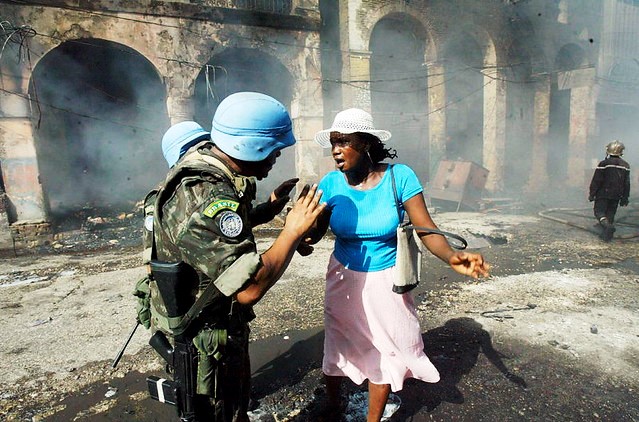
When groups of young "security" men came in buses with eviction notices, the camp residents chased them away with rocks, sticks and machetes. Residents did the same with aid workers who were merely trying to register their existence. "It's not like we're comfortable here," said Katlyne Camean. "Last night when it rained, I filled three buckets of water from my house. But no one is telling us where they want us to go. I don't want to go somewhere worse."
No one knows where to relocate more than a million people displaced by the Jan. 12 quake. The government and foreign aid groups want to move many back to their old neighborhoods or open spaces nearby and build single-family shelters for them. But to avoid roiling an already volatile situation, they must know who owns the land they're building on.
In Haiti, this requires stepping into a morass nearly as old as the country itself.
"The problem of title of ownership goes back 200 years in Haiti," President Rene Preval said in a recent interview. "If you put one after another, all of the titles in Haiti, you will find Haiti is bigger than the United States."
Haiti is, in fact, the size of Maryland. But generations of corruption, dictatorship, coups and spoils-system governance have reaped a vast number of cases where multiple people claim the same piece of property. "Sometimes all of their documents are validated," Preval said. "It's very hard to tell who started cheating first."
Against this deep-set obstacle, pressure is mounting: Owners of the land where the camps have popped up want compensation or the squatters off before they become entrenched and their houses permanent. There are increasing reports of forced evictions.
The Acra family claims the land under this camp. Sebastien Acra says the family hasn't tried to evict the people there. Nor has the government approached him to buy the land to build housing. He is more concerned with another camp on property about a mile away, where the family had plans to build a manufacturing center. When the earthquake hit, about 15,000 nearby residents set up stakes on the site. The Acras want them off, but there is no government plan for where to send them. "People get used to their environment very fast," Acra said."They're adapting. That's Haiti."
He said the issue is too politically sensitive to touch until after the elections scheduled for Nov. 28. "We know that now through elections, nothing will be done," Acra said.
Preval appeared aware of that as well. In the interview, he mentioned that "sometimes, you witness real wars over land." He set a goal to move the estimated 26,000 people in Champs de Mars, the plaza in front of the presidential palace, back to their old neighborhood of Fort National, a pilot project for what was to come. But he quickly realized how intractable the land issue was, and months later, the tent camp is still there. Even the original assumption that the people were mostly from Fort National turned out to be wrong.
Preval was so flummoxed by the problem that his view changed within the course of a conversation. He first cited audacious plans to build high-rise apartment buildings and use rubble to shore up more land in the harbor for hotels and commercial buildings, then acknowledged that he was stumped on what to do with the displaced in the years before those plans come to fruition. "I'm not going to tell the people the situation is simple," he said, then sighed. "I don't have the means to solve the problem."
In a portable office behind the palace, the civil engineer appointed by Preval to resolve the land issue, Marie George Salomon, says the plan is to raze the most damaged parts of Fort National and build orderly rows of wood-framed shelters. But the disorganized way in which the neighborhood grew, with narrow alleys and houses on top of houses, means the area held far more people than the rebuilt one ever will.
At least 10,000 people would be unable to move back. Multiply that by the hundreds of other camps, big and small, and the scope of the conundrum is clear.
The government has identified five big sites outside Port-au-Prince to which it could move thousands of people in the interim. But where would they work? Where would they find food? Haitians survive, in large measure, within a network of family and friends rooted deeply in their own neighborhoods. Forced relocations to government camps could set off a political firestorm.
Still, foreign aid groups trying to build temporary shelters are frustrated because Preval's government hasn't come up with some blueprint they can use. In some areas, they have worked with local officials to create a three-year moratorium on disputes over property. They simply build shelters for the families living on the land, be they renters, owners or squatters.
Even this has been slow going. Rubble remains everywhere. The groups can't demolish a heavily damaged house without the owners' permission. And many times, the space where a family lived is too small for one of the prefab shelters. So far about 11,900 shelters have been constructed, out of 135,000 planned.
"It's going to be a long process," said Lilianne Fan, the housing, land and property coordinator for the cluster of foreign groups trying to build shelters. "The camps are going to be there for a long time. We need everyone in Haitian society to understand this."
As officials struggle to work out these issues, the residents in the larger camp on the Acras' land are somehow convinced that the International Organization for Migration, which is in charge of registering people in the camps, wants to kick them out. "IOM is trying to put us at war!" resident George Kempes said.
Leonard Doyle, a spokesman for the organization in Haiti, said the rumor in the camp was that "registration is a step before eviction." "Never true," he said. "We never evict. Period."
Still, relief groups say the camp is in danger of flooding, especially now during hurricane season.
When Eddy Cantave arrived at the camp in March, the only land left was at the bottom, along a creek. He's living on a slick of silt that is swamped every time it rains.
In his tent, the mud sticks to your shoes. Most of his belongings are stacked on chairs. His bed is propped up on paint cans. An old black oven and a small Frigidaire, salvaged from his home, create a little bulwark to divert the water. He hung his paintings of his seaside hometown on the tarpaulin walls. When it rains, he stares at fishing boats and palm trees and thatched huts and prays not to be swept away.
******************************
Haiti’s Disaster Capitalists Swoop In
Who benefits when refugees are moved from camps into garment and cell-phone industry “work zones?”
By Siddhartha Mahanta, Mother Jones, September 14, 2010
Refugee evictions, private land grabs, disaster capitalism--ou can’t tell the story of Haiti without all this. Eight months after the earthquake, many of the 1.7 million Haitians living under tattered tarps in squalid squatter camps around Port-au-Prince are being forced to abandon the tent cities they’ve set up on privately owned land. Meanwhile, businesses—eager to slurp up the spoils of disaster—are swooping in to score major paydays by moving the refugees to new camps, some set to operate as industrial work zones. And there’s no one stopping it.
In March, Haitian landowners and police authorities began kicking displaced Haitians out of their makeshift cities at the behest of the owners of the land on which the camps sat. International Action Ties, a grassroots community development agency working in Haiti, says authorities are regularly flushing out the camps. The International Organization for Migration, which heads up the international aid response to the quake, has been unable to prevent expulsions and has been relegated to playing mediator between landowners and camp occupants. A recent IAT report provides a vivid blow-by-blow of expulsions by Haitian police in the communes of Delmas and Cité Soleil: bulldozers demolishing flimsy shelters, policemen swinging batons and shooting their guns in the air, and several cases of sexual assault. IAT skewers the Haitian government and UN system, and blasts the aid community for not defending the refugees (for more, read this report from July).
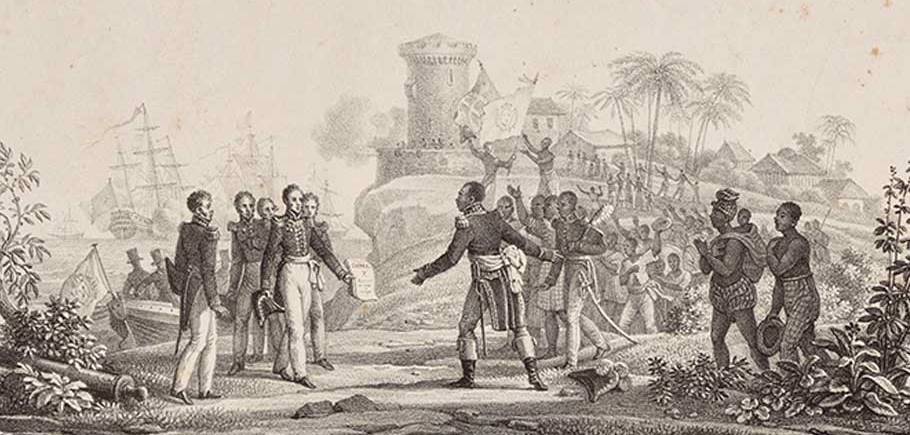
And there’s a twist: It’s not even clear these landowners officially own the property that the displaced people are being expelled from. Murky titling laws have plagued Haiti since its early days, clouding landowners’ claims with ambiguity and contributing to the country’s current catastrophe. Post-colonial Haiti’s first ruler, Jean-Jacques Dessaline, imposed dramatic land reforms in the early 1800s, apportioning plantation land among freed slaves. But after his assassination, subsequent efforts at reform failed, and military leaders appropriated old plantation land. Land titling gradually became more and more muddled as one dictator gave way to another. In the 1950s and ‘60s, François “Papa Doc” Duvalier meted out land to members of his death squads, or left property up for grabs. In the ‘80s, another attempt to formalize land holdings failed.
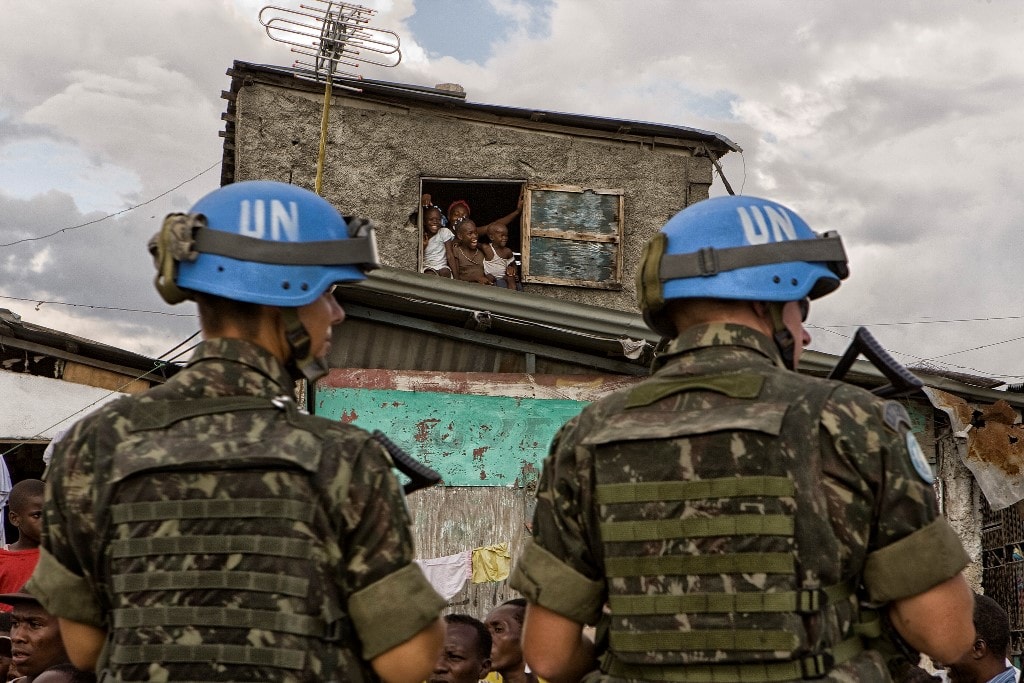
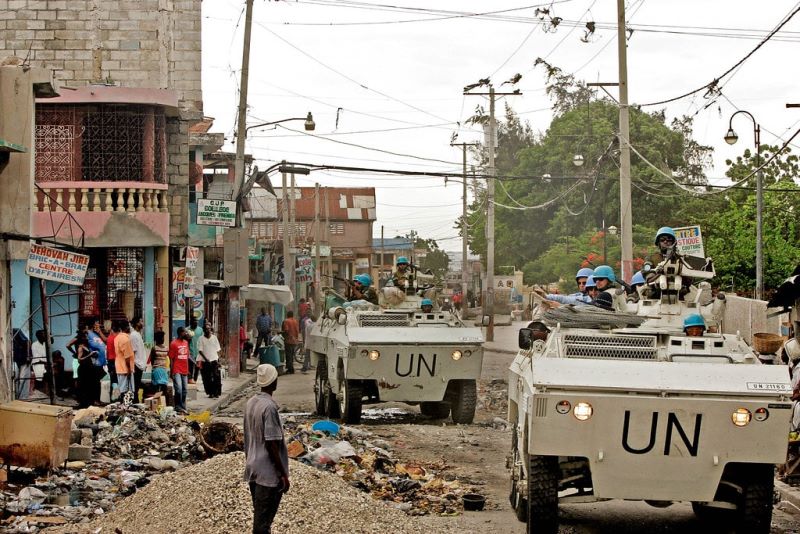
On January 11, 2010, the day before the quake, around 85 percent of Port-au-Prince’s residents lived on property of dubious ownership. “There’s no real registry to show who owns the land,” says Oxfam’s Julie Schindall. “On any given plot, there may be three people asserting themselves as landowners for any given reason.” IAT estimates that some 70 percent of landowners don’t bear title to the property they claim, and it demands a moratorium on evictions until the ownership chaos can be sorted out. In the interim, it’s the responsibility of the United Nations Stabilization Mission in Haiti to protect the human rights of Haitians, according to its mandate. That includes the right to shelter and housing. Haitian law, Schindall adds, clearly bars forced evictions.
The reasonable course would seem obvious: Sort out the legalities and the who-owns-what before ripping down tents and moving the stricken, the sick, and the dying out of the camps. But in March, President René Préval, under pressure from landowners and business elites, ordered aid groups to discontinue food services (though some limited distribution to pregnant women and children continued). This was seen as a move designed to put pressure on camps to disband.
In the absence of government leadership on this issue, businesses and NGOs are filling the gaps—and exploiting the situation. For instance, Nabatec, a consortium owned by some of Haiti’s most powerful families, and World Vision, a Christian humanitarian organization, plan to build a new city of 300,000 displaced Haitians, complete with garment factories, homes, stores, and restaurants. This new business zone will be in Corail Cesselesse, about nine miles from Port-au-Prince. Nabatec owns the land where the refugees will live, and stands to gain a chunk of the $7 million dollars the Haitian government plans to pay landowners who’ve given up property for the site.
“After I take people to Corail [Cesselesse], they don’t sleep well anymore,” says Melinda Miles, director of the aid group KONPAY. “It’s 40,000 people living in the middle of the desert.” She says that Corail Cesselesse, like other camps, has been without proper food distribution for the past two months; children in the camp have orange hair, a symptom of malnutrition. And Nabatec has positioned itself to make a killing as the commercial gatekeeper for private companies seeking to set up shop in Corail, including a South Korean garmet firm and a Vietnamese cell phone company.
With most NGOs not addressing the expulsion issue, many displaced Haitians remain at the mercy of landowners anxious to reclaim their property. They’re caught between an incapable government and a rush of foreign investment looking capitalize on a ruined country—just as hurricane season kicks up.
Siddhartha Mahanta is an editorial intern at Mother Jones.
*********************************
Building homes a struggle in Haiti
BY JACQUELINE CHARLES, Miami Herald September 13, 2010
CORAIL-CESSELESSE, Haiti -- It was promised as the place where those displaced from the Western Hemisphere's worst natural disaster could begin to rebuild their shattered lives as they await the birth of a new city.
Here, 12 miles north of a quake-ravaged Port-au-Prince, on a sun-beaten gravel plain, thousands left homeless by the catastrophic Jan. 12 earthquake would live in tents, then three months later move into studier shelters. Eventually, they would own permanent homes as part of a newly developed community offering government services sorely lacking in Haiti: running water and electricity. New factory jobs would follow nearby. Six months later, only a few plywood temporary shelters are up, and most of what was promised in Corail-Cesselesse has not been delivered. Instead, hundreds arrive daily with no control, grabbing private land around the emergency relocation camp. Rather than resemble a new Haiti, Corail is beginning to look like the old one as the barren mountain slopes and land surrounding it mushroom with thousands of shacks made of blue and gray tarp, and even cement block.
"Everyday, it is multiplying,'' said Frandy Roberts, 24, who moved into a flimsy white tent in April. Since then, he has watched as Corail threatens to become a menacing slum.
With more than 40,000 squatters now calling the once vacant land around Corail home, Haitians and foreign critics blame the international community for the ``disaster'' here. They say it was forced on the government of Haiti despite strong opposition from President René Préval.
"There is a tremendous responsibility from the international community for creating this monster,'' said Jean-Christophe Adrian, country manager for the United Nations Human Settlements Program in Haiti. ``It is addressing a minute number but creating a huge problem.''
'HOLLYWOOD, PENTAGON'
Adrian said Corail, officially home to 7,000 quake victims, is an example of what happens ``when Hollywood and the Pentagon get involve in humanitarian aid.
"It doesn't work,'' he said.
The reference is to both actor Sean Penn, who moved into a tent and took over the operation at the Pétionville Golf Course, and Lt. Gen. Ken Keen, who served as the commander of the joint U.S. military operation in the early days of the emergency response. Both were among several who pushed the government to find suitable land to relocate homeless quake victims living in areas considered to be at high-risk of flooding and landslides.
"They were completely wrong in evaluating the risks. Second, they were so desperate to show something concrete they've done here, that Corail was one of them,'' Adrian said. "That was really the wrong decision, creating Corail. All of this land that's supposed to be used for the future of Port-au-Prince now has been invaded.''
Penn said that the Corail-model is not the problem. Rather, it is the failure of the various U.N. organizations and nongovernmental organizations to follow through on the promises made to the families who voluntarily relocated, and to organizations like his, who assisted in the relocation.
"We were working toward an emergency relocation but only as part of a larger ongoing commitment and as agents of those who committed to it, and who later forfeited on their obligations,'' Penn told The Miami Herald by telephone from Michigan, where he's filming. ``It's sinful.''
Darryl Wright, a spokesman with U.S. Southern Command, said the U.S. military's job was to help assess high-risk camps, and builidngs' structures.
"This was done in conjunction with the United Nations, [Office for the Coordination of Humanitarian Affairs], the government of Haiti and the World Food Program,'' he said. "As of June 1, the task force no longer existed. "But the international community is not solely to blame. The Haitian government must also shoulder responsibility, some critics say.
Eight months after the quake killed an estimated 300,000 and left at least 1 ½ million homeless, Haiti still has no housing minister, policy or approved strategy.
Also, despite the signing of an executive order in March giving the government the right to seize 17,297 acres through eminent domain, the government still does not yet own the land.
Prime Minister Jean-Max Bellerive, who co-chairs the Interim Haiti Recovery Commission, said the government doesn't need to own the land right now. It just needs to ensure that available land is identified. "What we need, is to be sure . . . nobody can use it without permission from the government,'' he said.
But people are using the land without permission.
"The owners are seeing their land squatted on, and they don't have the capacity to fight the squatters or the pirates who are selling the land,'' said Leslie Voltaire, an urban planner involved in reconstruction planning.
Voltaire, who is also a presidential candidate in Haiti's Nov. 28 elections, said the government needs to go from "decision-making to decision-taking.''
The government, he says, is "so full of priorities that they can't choose'' where to focus.
For weeks, Voltaire said, the commission he heads has been awaiting a decision from both Préval and Bellerive on a two-part housing strategy it submitted. The strategy involves putting transitional shelters on demolished lots and helping people return home by providing them with a financial-assistance package to repair their quake-damaged homes.
In exchange for between $2,000 and $30,000 in assistance, building materials or a combination of the two, residents would have to agree to inspections of the work, and use certified workers trained in earthquake-resistant construction.
The second part of the strategy involves the planning of three future communities on the outskirts of the capital, including where Corail is located. The Inter-American Development Bank has designated money to hire a firm to do an urban layout, but the process is time-consuming. Voltaire fears that by the time it is done, "you can have 200,000 squatters " living in the hills around Corail. Bellerive said the government has various rebuilding strategies, including Voltaire's.
"Housing is not only a matter of land and construction, it is mostly a question of financing and management. How are we going to finance the construction? How are we going to guarantee the services for heavy concentration of population? We cannot rebuild slums,'' he said.
TEMPORARY SHELTER
Only 13,073 temporary shelters have been built throughout Haiti out of a goal of 135,000 by the end of next August, according to the shelter cluster. Fewer than 100 temporary shelters have been completed at Corail.
Even before the earthquake wiped out 100,000 homes, Haiti struggled with a massive housing shortage as its impoverished masses haphazardly built any how and anywhere. Few places show the complexity of rebuilding than Fort National, a slum community not far from the caved-in National Palace.
Préval has been dispatching government bulldozers and other heavy equipment to the neighborhood to remove rubble. He's asked NGOs to redirect cash-for-work dollars to area residents to involve them in the clean up. And Préval has been championing the idea of replacing residents' concrete shacks with multistory apartment buildings.
"We've always promoted the idea that people should be encouraged to go back home and that's what Fort National is about,'' said Adrian, the U.N. housing expert.
This summer, after being deluged with housing requests, Bellerive and Clinton endorsed the idea of an international housing expo of anti-seismic houses for Haiti. Some 380 proposals were received.
A jury will soon choose the best five models, which will be a living showcase in a planned community on government-owned land in Port-au-Prince. Quake victims will live in them, and the idea is to replicate the housing designs throughout Haiti.
But until that happens, frustrations continue to grow in and around Corail as residents wait on temporary plywood shelters that have been slow in coming.
"I am very frustrated,'' said Jean Saint-Ange Darius, the mayor of Croix-des-Bouquets, where Corail is located. "What you have threatening here is what you see in the mountains of Port-au-Prince.''