
Haiti is the oldest Black republic in the world and one of the most misread. We built this Haiti news network to answer one question plainly: what is happening in Haiti, and why. Below you’ll find the history, the numbers, and the context – from the 1804 revolution to the 2026 gang crisis, from Canada’s $460 million aid commitment to the 180,000 Haitians living in Quebec.

11.9M
Population of Haiti
52%
Face acute food insecurity (2026)
1.4M
Internally displaced (2025)
$460M
Canadian aid, 2022–2025
Haiti in Numbers
Fact | Data | Source |
|---|---|---|
Population | 11.9 million | FAO, 2026 |
Official languages | French, Haitian Creole | |
Independence | January 1, 1804 – first Black republic in the world | |
2010 earthquake | Magnitude 7.0 · est. 220,000+ deaths · 1.5M displaced | USGS / UN OCHA |
Internally displaced (2025) | 1.4 million people (12% of population) | IOM / OCHA |
Acute food insecurity (2026) | 5.8–5.9 million people – 52% of population | IPC / WFP |
Haitian-Canadian diaspora | 180,000 – 90%+ in Quebec | Global Affairs Canada, 2025 |
GDP per capita | $1,800 USD | IMF, 2023 |
A Brief History of Haiti
Few countries carry as much history in as small a space as Haiti. To understand today’s debt burden, political instability, and cycles of international intervention, you have to start in 1791, and work forward. The key dates below aren’t background. They are the direct causes of the present.
The Haitian Revolution and Independence (1791–1804)
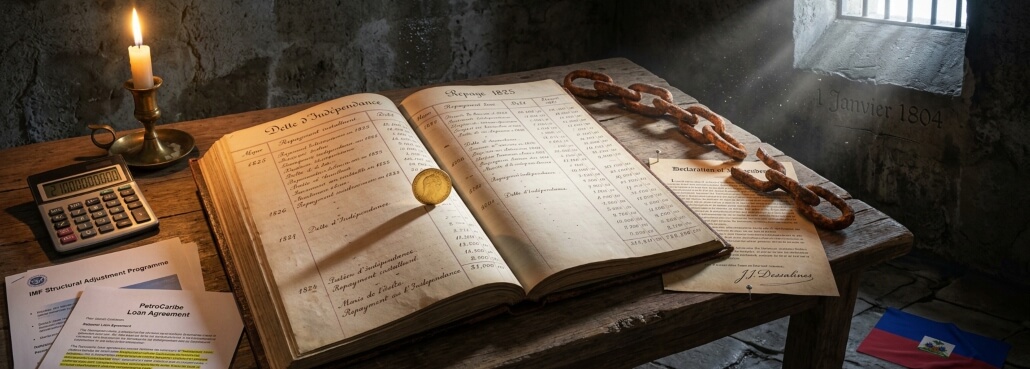
Haiti’s founding story is one of the most extraordinary in modern history. In 1791, enslaved people on the French colony of Saint-Domingue launched a revolt – the only successful slave revolution in recorded history. After thirteen years of fighting against French, Spanish, and British forces, Haiti declared independence on January 1, 1804, becoming the first Black-ruled republic in the world.
The price of that independence was steep. In 1825, France demanded 150 million gold francs, later reduced to 90 million, in exchange for diplomatic recognition. Haiti spent over a century repaying what historians have called an illegitimate debt. Economists estimate the total cost, in modern terms, at roughly $21 billion. This is the starting point for understanding Haiti’s economic history. As analysts have noted, debt is Haiti’s real curse, a thread running from 1825 to IMF structural programs to PetroCaribe.
Key dates in Haitian history
1804: Independence declared · 1825: French indemnity imposed · 1915–1934: US occupation · 1957–1986: Duvalier dictatorship · 1990: First free elections · 1991 & 2004: Aristide removed from office · 2010: Earthquake · 2021: President Moïse assassinated · 2025: Gang Suppression Force authorized
US Occupation, the Duvalier Era, and Modern History
The United States occupied Haiti from 1915 to 1934, controlling its finances and military. Decades later, François “Papa Doc” Duvalier seized power in 1957, backed by a feared paramilitary group, the Tonton Macute. His dictatorship, continued by his son Jean-Claude “Baby Doc” until 1986, drove hundreds of thousands of Haitians into exile – many to Quebec, forming the core of today’s Haitian-Canadian community.
Jean-Bertrand Aristide won Haiti’s first free elections in 1990, was ousted in a military coup the following year, and returned to power with UN support in 1994. He was elected again in 2000 and removed from office in February 2004 in circumstances that remain contested. Canadian, US, and French forces participated in the multinational response. The UN mission MINUSTAH was deployed shortly after and stayed for 15 years.
Canada and Haiti: Foreign Policy, Aid, and Military Presence
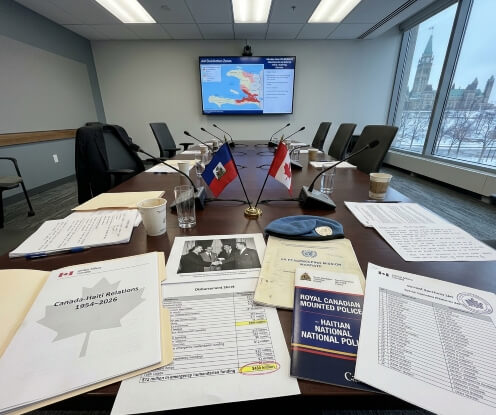
Canada and Haiti established formal diplomatic relations in 1954. Since then the relationship has been shaped by shared language, the large Haitian-Canadian diaspora, and Canada’s strategic interest in Caribbean stability. Canada for Haiti has meant, at different times: peacekeeping missions, development funding, police training, and sanctions against individuals fueling violence.
Development Assistance
Between 2022 and 2025, Canada provided $460 million in international assistance to Haiti, making it one of Canada’s largest aid commitments in the Americas. In 2024, Canada disbursed $12 million in emergency humanitarian funding for food, water, sanitation, health services, and gender-based violence protection. Canada currently chairs the UN ECOSOC Ad Hoc Advisory Group on Haiti and has imposed targeted sanctions on 34 individuals responsible for fueling instability, under the Special Economic Measures Act.
Year / Period | Canadian Action | Scale |
|---|---|---|
1995–1997 | Major CAF peacekeeping operation | 500–750 personnel |
2004 | Peacekeeping after Aristide’s removal | 500 personnel |
2010 | Earthquake relief | 2,000+ CAF personnel |
2022–2025 | International assistance | $460 million |
2024 | Humanitarian assistance | $12 million |
Sept 2025 | GSF + Maritime Security | $60 million |
Total (MSSM + GSF) | Security mission support | $126 million+ |
Bilateral trade remains modest: in 2024 total merchandise trade reached $155.2 million – $103.2M in Canadian exports (agri-food, machinery, automobiles) and $52M in Haitian imports, mostly textiles and seafood.
Military Presence: From MINUSTAH to the Gang Suppression Force
Canada has maintained a continuous military and police presence in Haiti since the mid-1990s. Its engagement has always been heavily supported by foreign governments, including Canada, alongside the US, France, and UN partners. The RCMP has trained Haitian national police for decades; two RCMP officers, Sgt. Mark Gallagher and Chief Supt. Douglas Coates, were killed in the 2010 earthquake while on a training mission.
Among the more contested figures in recent Haitian history is Guy Philippe, a former police chief and military leader, described in press coverage as a mercenary and sometimes coup leader, who was arrested in 2017 by US DEA agents on drug trafficking charges. His case illustrates the blurred lines between political power, armed groups, and foreign intelligence interests that have defined Haitian security for decades.
The most recent international mission, the Kenyan-led Multinational Security Support Mission (MSSM), was authorized in 2023 but peaked at under 1,000 officers against a ceiling of 2,500 and suffered from chronic underfunding. On September 30, 2025, the UN Security Council voted 12–3 to authorize a successor: the Gang Suppression Force (GSF), with a ceiling of 5,550 troops and direct UN logistical support. Canada has contributed $126 million+ to both missions. As of April 2026, a Chadian advance team has arrived in Port-au-Prince under South African commander Jack Christofides.
The 2010 Earthquake: Impact, Aid, and the Effectiveness Debate
The January 2010 earthquake is the single event most associated with Haiti in international memory, and also the one most subject to competing narratives. What the numbers show, what grassroots reporting from Haiti revealed, and what official aid tallies claimed were three very different stories.
Scale and Immediate Response
On January 12, 2010, a magnitude 7.0 earthquake struck near Port-au-Prince, killing an estimated 220,000 or more people and displacing 1.5 million. More than 2,000 Canadian Armed Forces personnel deployed in the weeks that followed. Partners in Health, co-founded by Dr. Paul Farmer, opened a teaching hospital in Mirebalais in 2012 that became a model for public health infrastructure in low-income settings.
Aid Pledges, Disbursements, and Grassroots Reporting
At a donors’ conference in March 2010, international pledges reached approximately $13 billion. What was delivered, and how, became one of the most debated questions in international development. The Center for Economic and Policy Research tracked disbursements closely: as Mark Weisbrot noted in a 2014 report, reconstruction remained critically incomplete years after the earthquake, with significant portions of pledged funds never reaching Haiti or returning to donor countries through procurement and salaries.
Grassroots reporting from Haiti, journalists and civil society organizations documenting conditions on the ground, consistently told a different story from official aid tallies. The gap between headline pledges and lived reality on the ground became a defining narrative of the post-earthquake period. The so-called aid racket, a structure of humanitarian funding that critics argue serves donor interests as much as recipient needs, was examined by journalists at multiple outlets, from the Washington Post to The Intercept. This doesn’t mean all aid failed: organizations like Partners in Health, SOIL, and SOPUDEP made demonstrable, lasting contributions.
Donor | Pledged (2010) | Context |
|---|---|---|
United States | $1.15 billion | Largest single donor |
European Union | $1.6 billion | Collective EU pledge |
Canada | $400 million | Earthquake + reconstruction |
Venezuela | $2.8 billion | Mostly PetroCaribe energy credit |
World Bank | $100 million | Immediate post-quake |
As of 2026, OCHA’s Humanitarian Response Plan for Haiti requires $880 million but has received less than 20% of that amount.
UN Presence, Cholera, and Human Rights
The United Nations has been a near-constant presence in Haiti since 2004. That presence has been credited with stabilizing a fragile state, and blamed for introducing cholera, enabling sexual abuse, and prolonging a form of occupation that Haitians never voted for. Both assessments are supported by evidence.
MINUSTAH and MINUJUSTH (2004–2019)
The UN Stabilization Mission in Haiti (MINUSTAH) was deployed in May 2004 and remained, in various forms, until 2019. These missions generated serious controversies that continue to shape how Haitians perceive international intervention.
The Cholera Epidemic
In October 2010, less than a year after the earthquake, cholera appeared in Haiti for the first time in over a century. Epidemiological evidence traced the outbreak to a MINUSTAH base in the Artibonite region. The epidemic infected more than 820,000 people and killed approximately 10,000. Among those who documented the human cost most closely was Haitian journalist and activist Junia Barreau, whose reporting brought international attention to affected communities.
The UN denied responsibility for years. In 2016, Secretary-General Ban Ki-moon formally acknowledged the UN’s “significant role” in the outbreak, a historic admission that fell short of the full accountability and reparations demanded by Haitian civil society. Legal actions against the UN were pursued by the Bureau des Avocats Internationaux (BAI) and the Institute for Justice and Democracy in Haiti (IJDH).
The Current Security Crisis (2021–2026)
After the assassination of President Jovenel Moïse in July 2021, Haiti descended into what the UN describes as a “multidimensional crisis.” Armed gangs, organized under the coalition “Viv Ansanm,” have consolidated control over large parts of Port-au-Prince and expanded into three of Haiti’s ten departments. Mass protests, some of the largest in Haitian history, erupted in 2018 and 2019 over corruption and government failures, foreshadowing the collapse that followed.
According to OHCHR, more than 16,000 people were killed or injured since January 2022, with 8,100+ killed in the first eleven months of 2025 alone. Haiti has been described by some analysts as having the highest homicide rate in the world. An estimated 300 criminal groups are active, with 270,000–500,000 illegal firearms in circulation.
WikiLeaks, Diplomatic Cables, and Press Freedom
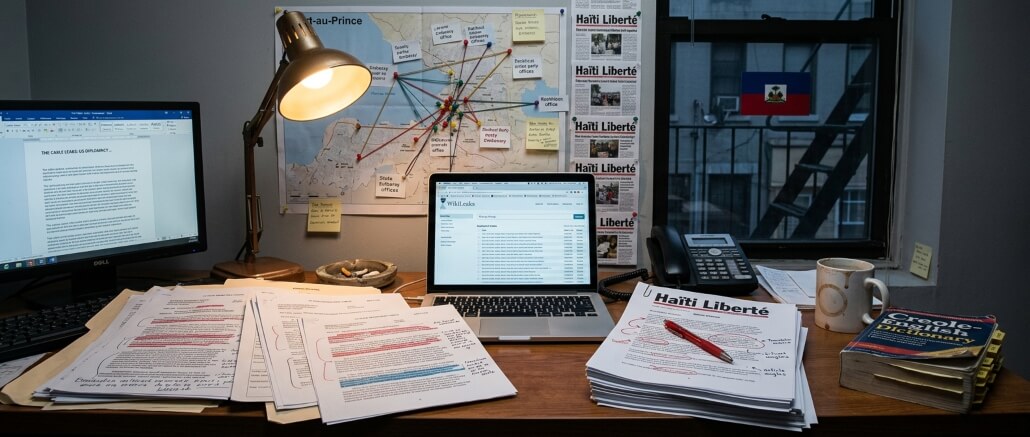
In 2010 and 2011, thousands of diplomatic cables released by WikiLeaks, including communications from the US Embassy in Port-au-Prince, revealed frank assessments of Haitian politicians, security conditions, and international strategy. The newspaper Haïti Liberté, published in New York and Port-au-Prince, was among the first to publish English translations of these cables, making them accessible to a wider audience and generating significant political debate.
Economy, Labour, Free Trade, and Haiti’s Debt
Over 66% of Haiti’s 11.9 million people live on less than $3.65 per day. Only 51% have access to electricity. 35% lack clean drinking water. The economy has been in recession for six consecutive years. These are not natural conditions, they have structural roots in trade policy, foreign debt, and the weakness of the Haitian state.
The Garment Industry and Women’s Rights
Haiti’s garment assembly sector employs roughly 55,000 workers, the large majority of them women. Women’s rights in this sector – wages, workplace safety, protection from harassment – have been central to labor rights advocacy in Haiti for decades. The country has long been promoted as a potential “Taiwan of the Caribbean” for low-cost manufacturing, but wages have remained among the lowest in the hemisphere. Beverly Bell and Alexis Erkert of Other Worlds have documented conditions extensively, and their work has informed international campaigns for minimum wage reform.
Free Trade and the Collapse of Haitian Agriculture
In the 1990s, under IMF and World Bank pressure, Haiti slashed agricultural import tariffs. Subsidized American rice flooded the market at prices local farmers couldn’t match. Domestic rice production collapsed within a decade, turning Haiti from near self-sufficiency into a net importer of its staple food. This is what critics, including Tèt Kole Ti Peyizan Ayisyen, Haiti’s largest peasant farmers’ movement, call “free trade voodoo”: policies sold as modernization that functionally dismantled local food systems.
Today, gang violence compounds the food crisis: farmers in gang-controlled areas are forced to negotiate access to their own land and share their harvests. As of April 2026, 5.8 million Haitians, 52% of the population, face acute food insecurity (IPC/WFP), with 600,000 in famine conditions.
Haiti’s Debt Burden
Debt is Haiti’s real curse, a thread connecting the 1825 French indemnity to today’s financial constraints.
Period | Event | Impact |
|---|---|---|
1825 | France demands 150M gold francs for recognizing independence | Haiti repaid until 1947; estimated modern cost $21 billion |
1915–1934 | US occupation controls Haiti’s finances and customs | Debt structured to serve US banking interests |
1990s–2000s | IMF structural adjustment programs | Required trade liberalization; agricultural and social spending cut |
2010 | Post-earthquake debt cancellation by IMF, World Bank, IDB | $1.2 billion in outstanding debt cancelled |
2010s | Venezuela’s PetroCaribe: forgave over $395 million | Largest single debt relief from a partner country |
Venezuela’s decision to forgive over $395 million in Haitian debt through PetroCaribe was the most significant bilateral debt relief in Haiti’s modern history, and a point of contention in subsequent political disputes over how those funds were managed.
Politics, Elections, and Governance
Haiti’s political history since 2004 has been marked by contested elections, international intervention, and recurrent instability. Michel Martelly served as president from 2011 to 2016. Jovenel Moïse won disputed elections in 2016 and was assassinated in July 2021, an unsolved case. Since then, Haiti has operated without elected officials at any level.
A Transitional Presidential Council, established in April 2024, governed until its mandate expired in February 2026. Current Prime Minister Alix Didier Fils-Aimé leads a caretaker government. Elections remain distant as mass protests over insecurity and political dysfunction continue, and gang control of Port-au-Prince prevents basic civic functions.
The newspaper Haïti Liberté – bilingual, published in New York and Port-au-Prince – has been a consistent source of political analysis since 2006, including publishing English translations of the WikiLeaks cables released by the US Embassy in Port-au-Prince. The Center for Economic and Policy Research (CEPR), through analysts including Mark Weisbrot, has provided ongoing economic and political analysis of Haiti from a critical perspective.
Civil Society, Culture, and the Haitian Diaspora in Canada
The Haitian-Canadian Community
Canada is home to approximately 180,000 Haitians, over 90% in Quebec, with growing communities in Ontario and British Columbia. The community maintains deep cultural and economic ties with Hait, remittances are one of Haiti’s most stable sources of foreign income.
Canadian media has covered Haiti extensively. CBC Radio’s The Current has been a key platform for Haitian voices, interviewing journalists, scholars, and community leaders on everything from earthquake recovery to the gang crisis. Haitian music has also crossed over: Grammy-nominated anthologies of historic Haitian recordings and contemporary compas artists have brought Haitian musical heritage to wider audiences.
Civil Society Organizations
Several organizations have played significant roles in documenting and responding to Haiti’s situation:
- Canada Haiti Action Network (CHAN) – a Canadian solidarity organization based in Vancouver, Winnipeg, and Montreal, active from approximately 2004 to 2019, that monitored Canadian foreign policy toward Haiti and published bilingual analysis.
- Tèt Kole Ti Peyizan Ayisyen – Haiti’s largest peasant farmers’ movement, active in food sovereignty and land rights advocacy.
- Partners in Health (Zanmi Lasante) – co-founded by Dr. Paul Farmer, operating health facilities including the University Hospital in Mirebalais.
- Sustainable Organic Integrated Livelihoods (SOIL) – ecological sanitation and soil restoration in Haiti.
- SOPUDEP – a grassroots community school in Port-au-Prince serving children without access to formal education.
- Bureau des Avocats Internationaux (BAI) and the Institute for Justice & Democracy in Haiti (IJDH) – legal advocacy pursuing UN accountability for cholera and documenting human rights violations.
Bitter Cane (1983), directed by Jacques Arcelin, remains one of the most important documentary films about Haiti, examining the Duvalier era and the role of the sugar industry in Haitian poverty.
Frequently Asked Questions
Haiti became the world’s first Black republic on January 1, 1804, after the only successful slave revolution in history. Its subsequent history includes a French-imposed debt that took over a century to repay, US military occupation from 1915 to 1934, decades of Duvalier dictatorship, and recurring cycles of political instability and international intervention.
Haiti is experiencing a severe multidimensional crisis. Armed gangs control large parts of Port-au-Prince and have expanded into multiple regions. Over 1.4 million people are internally displaced. 5.8 million, 52% of the population, face acute food insecurity. A new UN-backed Gang Suppression Force (GSF) began deploying in April 2026 to replace the underfunded Kenyan-led mission. Elections have not been held since 2016.
Canada is one of the largest donors to Haiti’s stabilization efforts, providing $460 million in assistance between 2022 and 2025. Canada supports the Haitian National Police through training and equipment, chairs the UN ECOSOC Advisory Group on Haiti, and has contributed $126 million+ to international security missions. Canada has also imposed sanctions on 34 individuals responsible for fueling violence.
A magnitude 7.0 earthquake struck near Port-au-Prince on January 12, 2010. Estimates of the death toll range widely. Most assessments are around 220,000. Over 1.5 million people were displaced. International pledges reached $13 billion, but researchers including Mark Weisbrot documented significant gaps between pledges and actual disbursements.
Cholera appeared in Haiti in October 2010, traced to a UN MINUSTAH base in the Artibonite region. The outbreak infected over 820,000 people and killed approximately 10,000. After years of denial, the UN Secretary-General acknowledged in 2016 that the organization played a “significant role.” Full reparations have not been paid.
Haiti’s debt burden begins in 1825, when France demanded 150 million gold francs in exchange for recognizing independence. Haiti spent over a century repaying. IMF programs in the 1990s required trade liberalization that damaged local agriculture. The 2010 earthquake prompted $1.2 billion in debt cancellation. Venezuela forgave over $395 million through PetroCaribe. Debt remains central to understanding Haiti’s underdevelopment.
The GSF is a UN Security Council-authorized multinational force established in September 2025 to replace the Kenyan-led Multinational Security Support Mission. It has a ceiling of 5,550 troops, direct UN logistical support, and a mandate to neutralize criminal gangs. Canada has contributed $126 million+ to the combined effort. As of May 2026, a Chadian advance team is on the ground under South African commander Jack Christofides.
Haïti Liberté is a bilingual Haitian newspaper published in New York and Port-au-Prince. Founded in 2006, it has provided consistent political coverage of Haiti, including publishing English translations of WikiLeaks diplomatic cables relating to Haiti and US Embassy communications about the country’s political situation.
Sources and References
- Global Affairs Canada – Canada-Haiti Relations (2025): canada.ca
- Veterans Affairs Canada – Haiti peacekeeping history: veterans.gc.ca
- UN OCHA 2026 Humanitarian Needs and Response Plan for Haiti: unocha.org
- IPC / WFP – Haiti Acute Food Insecurity Analysis, April 2026: ipcinfo.org
- Human Rights Watch – World Report 2026: Haiti: hrw.org
- UN Security Council Report – Haiti Monthly Forecasts (2026): securitycouncilreport.org
- Global Centre for the Responsibility to Protect – Haiti, March 2026: globalr2p.org
- PassBlue – The New UN-Backed Anti-Gang Force Arrives in Haiti, May 2026: passblue.com
- Chatham House – A Roadmap for Security and Governance Reform in Haiti, January 2026
- Center for Economic and Policy Research (CEPR) – Haiti analysis: cepr.net
- FAO – Haiti Emergency and Resilience Plan 2026–2028: fao.org
- IMF – Haiti Article IV Reports; World Bank – Haiti Overview: worldbank.org
Note on domain history: The domain previously hosted the Canada Haiti Action Network (CHAN), a Canadian solidarity organization active from approximately 2004 to 2019. This site is not a continuation of that organization and is not affiliated with CHAN or any of its former editors.